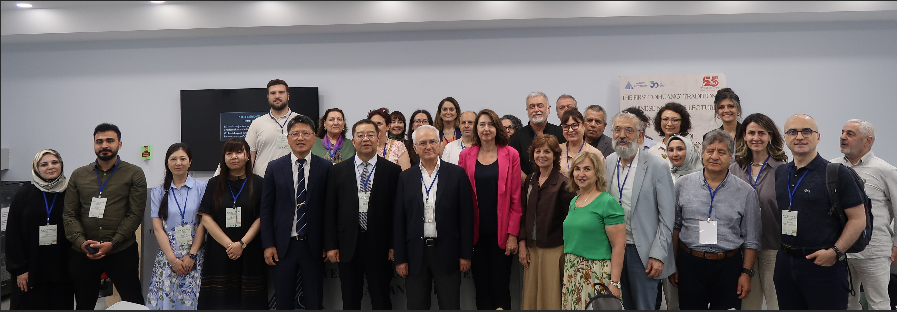


To mark the 55th anniversary of the establishment of diplomatic relations between China and Türkiye and to boost the international development of Traditional Chinese Medicine (TCM), the first “Qihuang” TCM Lecture was successfully held at the affiliated hospital of Yeditepe University in Istanbul on June 12, 2026.
Co-hosted by the Confucius Institute at Yeditepe University and the Istanbul Association of Acupuncture and Complementary Medicine, the event invited Professor Guo Yongming, Dean of the School of Acupuncture and Tuina at Tianjin University of Traditional Chinese Medicine and Vice President of the Tianjin Acupuncture Society, as the keynote speaker. More than 40 Turkish experts and scholars engaged in TCM research, as well as practicing acupuncturists from various local hospitals, attended the lecture. Combining theoretical explanations with practical demonstrations, the program explored the theories of TCM and elaborated on traditional acupuncture techniques, presenting the latest research achievements of TCM in a pleasant and interactive atmosphere.
Professor İlhan Öztekin, Director of the Acupuncture Department of Yeditepe University Affiliated Hospital and President of the Istanbul Association of Acupuncture and Complementary Medicine, Professor Natalya Ketenci, Foreign Dean of the Confucius Institute at Yeditepe University, and Liu Songyan, Chinese Dean of the Confucius Institute, attended the opening ceremony.
At the start of the lecture, Professor Guo quoted an ancient Chinese saying: “A physician is a healer; medical practice is the art of safeguarding human life.” Using plain language, he led participants to discuss the core theories of TCM acupuncture therapy and explained the differences between “Spirit” and “Qi” in TCM.
Later, Professor Guo focused on traditional acupuncture techniques, elaborating on the evolution and practical effects of acupuncture. He noted that the Huangdi Neijing (The Yellow Emperor’s Internal Classic) recorded in detail the forms and clinical applications of the “Nine Classical Needles,” laying a solid foundation for acupuncture to develop into a systematic therapy. Acupuncture features targeted treatments for a wide range of common illnesses.
Following the theoretical session, Professor Guo gave live demonstrations of acupuncture therapies for cervical spondylosis and hypertension. The demonstrations aroused great interest among the attendees, who stepped forward one after another to practice the delicate needling techniques and experience the unique sensation of Deqi (“arrival of qi”).Throughout the lecture, medical practitioners from across Türkiye gained a more systematic understanding of TCM acupuncture. Through hands-on practice, they experienced first-hand the profound heritage and unique charm of this traditional therapy.
The three-day “Qihuang” lecture series aims to build a high-level cross-cultural academic exchange platform. It facilitates the sharing of research findings and clinical experience between Chinese and Turkish experts, promotes dialogue between TCM and modern medicine, and drives the popularization and development of acupuncture, tuina and other characteristic TCM therapies in Türkiye. The event strives to bring the wisdom of TCM to benefit the health of the Turkish people and to contribute the strength of Traditional Chinese Medicine to building a global community of health for all.